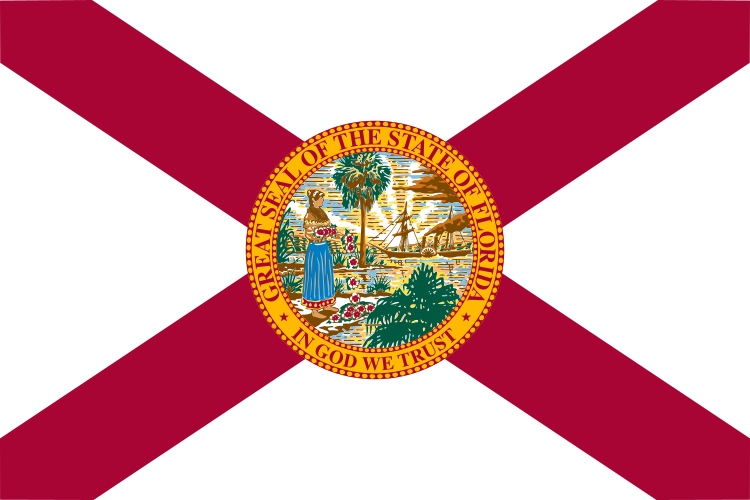
1031 Exchange in Florida
Florida follows federal 1031 exchange rules and offers a significant advantage in that it imposes no personal income tax on capital gains, so the only income tax deferred in a Florida exchange is federal. Florida's vulnerability to hurricanes and flooding creates unique considerations for investors, while its documentary stamp tax on deeds must be factored into exchange calculations. Note that the documentary stamp tax is not deferred by a 1031 exchange and applies to the transfer of any Florida real estate.
Fast Facts
- State Income Tax on Capital Gains
- None for individuals. Florida imposes no personal income tax (Fla. Const. art. VII, s. 5), so individual investors owe no state tax on capital gains. Note that C corporations are subject to Florida's 5.5% corporate income tax.
- Conforms to Federal 1031
- Yes. With no personal income tax, Florida imposes no state-level gain recognition of its own; federal 1031 exchange rules govern the exchange without additional state-specific filing requirements.
- Documentary Stamp Tax on Deeds
- 70 cents per $100 of consideration (0.70%) in all counties except Miami-Dade. In Miami-Dade County the rate on deeds is 60 cents per $100 (0.60%), plus a 45-cent-per-$100 surtax on transfers that are NOT single-family dwellings (bringing non-single-family transfers to $1.05 per $100, or 1.05%). This tax is imposed on the deed itself and is not deferred by a 1031 exchange.
- Homestead Exemption
- Not applicable to investment properties. Florida's Homestead Exemption provides property tax savings on primary residences but does not apply to investment properties involved in 1031 exchanges.
- Flood Zone Considerations
- Required for many properties. Due to Florida's vulnerability to flooding, many properties require flood insurance, which can significantly impact operating costs and should be factored into exchange calculations.
Legislative Updates
IRS Disaster Relief for Section 1031 Exchanges (Hurricanes Helene & Milton)
Following Hurricanes Helene and Milton, the IRS (in FL-2024-10, issued October 11, 2024) postponed a range of federal tax deadlines for affected Florida taxpayers, and under Revenue Procedure 2018-58 this relief can extend the 45-day identification and 180-day exchange deadlines for qualifying 1031 exchanges. The general postponement period ran through May 1, 2025. This relief has expired; it is noted here as a historical precedent for how federally declared disasters can extend exchange deadlines.
Vacation Rental Preemption Bill (SB 280) Vetoed
Governor DeSantis vetoed SB 280, which would have shifted more short-term/vacation rental regulatory authority to the state. As a result, Florida's existing 2011 preemption framework and the local-ordinance patchwork remain in effect: local governments generally cannot ban vacation rentals or cap the frequency/duration of stays (unless grandfathered by an ordinance in place before June 1, 2011), but may still regulate registration, safety, noise, parking, and occupancy.
Legal and Tax Considerations
State Income Tax on Capital Gains
None for individuals. Florida imposes no personal income tax (Fla. Const. art. VII, s. 5), so individual investors owe no state tax on capital gains. Note that C corporations are subject to Florida's 5.5% corporate income tax.
Conforms to Federal 1031
Yes. With no personal income tax, Florida imposes no state-level gain recognition of its own; federal 1031 exchange rules govern the exchange without additional state-specific filing requirements.
Documentary Stamp Tax on Deeds
70 cents per $100 of consideration (0.70%) in all counties except Miami-Dade. In Miami-Dade County the rate on deeds is 60 cents per $100 (0.60%), plus a 45-cent-per-$100 surtax on transfers other than single-family dwellings (non-single-family transfers total $1.05 per $100, or 1.05%). The tax is imposed on the deed and is not deferred by a 1031 exchange.
Homestead Exemption
Not applicable to investment properties. Florida's Homestead Exemption provides property tax savings on primary residences but does not apply to investment properties involved in 1031 exchanges.
Flood Zone Considerations
Required for many properties. Due to Florida's vulnerability to flooding, many properties require flood insurance, which can significantly impact operating costs and should be factored into exchange calculations.
Required Documentation
- Federal Form 8824
- Complete closing statements for both properties
- Qualified Intermediary agreement
Clawback Rule
None
Official References
Step-by-Step Process
- 1
Identify Replacement Property
You must identify potential replacement properties within 45 days of selling your relinquished property. In Florida, consider regional market differences, coastal versus inland locations, and flood zone status when identifying properties.
- 2
Engage a Qualified Intermediary
Work with a qualified intermediary to handle the exchange funds and documentation. Florida has numerous experienced QIs who understand the local market and can help navigate the state's unique considerations.
- 3
Close on Replacement Property
Complete the purchase of your replacement property within 180 days of selling your relinquished property. Be aware of Florida's documentary stamp tax, which will apply to the transaction.
- 4
File Tax Returns
Report your 1031 exchange on your federal tax return using Form 8824. While Florida does not tax capital gains, you must still report the transaction on your federal return.
- 5
Natural Disaster Considerations
Florida's vulnerability to hurricanes and flooding adds a unique layer of risk to real estate investments. When selecting replacement properties, carefully evaluate flood zone status, windstorm insurance requirements, and building code compliance. These factors can significantly impact property values, insurance costs, and long-term viability.
- 6
Documentary Stamp Tax Planning
Florida imposes a documentary stamp tax on deeds: 70 cents per $100 of consideration (0.70%) in every county except Miami-Dade. In Miami-Dade the rate is 60 cents per $100 (0.60%), plus a 45-cent surtax per $100 on transfers that are not single-family dwellings (so non-single-family transfers total $1.05 per $100). This tax is not deferred by a 1031 exchange, so factor it into the economics of any Florida-situated leg of your exchange.
- 7
Seasonal Market Considerations
Florida's real estate market can have significant seasonal fluctuations, particularly in tourist-oriented areas. This seasonality can affect both the timing of your exchange and the valuation of properties. Consider these patterns when planning your 45-day identification period and 180-day exchange period.
Timeline Calculator
Enter your relinquished property transfer date and tax return due date (including extensions, if applicable) to calculate your 1031 exchange deadlines:
Optional. If not provided, the calculator shows day 180 as provisional. Confirm your applicable due date with a qualified tax professional.
Common Pitfalls
Underestimating insurance costs
Issue
Florida property insurance costs, particularly for windstorm and flood coverage, can be substantially higher than in many other states, significantly impacting cash flow projections.
Prevention
Obtain detailed insurance quotes during your due diligence period, including windstorm, flood, and standard property coverage. Consider properties in areas with lower insurance rates or newer construction that meets current building codes, which can qualify for insurance discounts.
Overlooking flood zone status
Issue
Many Florida properties are located in flood zones, which can significantly impact insurance costs and future resale value.
Prevention
Verify the flood zone status of any potential replacement property and obtain flood insurance quotes before completing your identification. Consider the long-term implications of sea level rise and changing flood maps on coastal or low-lying properties.
Failing to account for seasonal market variations
Issue
Many Florida markets, particularly in tourist areas, have significant seasonal fluctuations in occupancy and rental rates that affect cash flow projections.
Prevention
Research seasonal patterns in your target market and factor these fluctuations into your financial projections. Consider properties with a mix of short-term and long-term rental potential to smooth out seasonal variations.
Underestimating documentary stamp tax
Issue
Florida's documentary stamp tax on deeds (70 cents per $100, or 0.70%, in all counties except Miami-Dade; 60 cents per $100 plus a 45-cent surtax on non-single-family transfers in Miami-Dade) can significantly impact transaction costs and is not deferred by a 1031 exchange.
Prevention
Factor the documentary stamp tax into your exchange calculations. Because all parties to the deed are liable for the tax under Florida law, confirm in the contract which party will pay it; in some cases it may be possible to negotiate the allocation, particularly in a buyer's market.
Frequently Asked Questions
Does Florida have a state income tax on capital gains?
No. Florida imposes no personal income tax (Fla. Const. art. VII, s. 5), so individual investors pay no state tax on capital gains — a significant advantage for real estate investors, particularly those from higher-tax states. One caveat: C corporations doing business in Florida are subject to the state’s 5.5% corporate income tax.
What is Florida’s documentary stamp tax?
Florida imposes a documentary stamp tax on deeds. In every county except Miami-Dade the rate is 70 cents per $100 of consideration (0.70%). In Miami-Dade County the rate is 60 cents per $100 (0.60%), plus a 45-cent-per-$100 surtax on transfers that are not single-family dwellings, so non-single-family transfers total $1.05 per $100 (1.05%). The tax is charged on the deed transferring Florida real estate and is not deferred by a 1031 exchange.
How do Florida’s hurricane and flood risks affect 1031 exchanges?
Florida’s vulnerability to hurricanes and flooding creates unique considerations for 1031 exchanges. Investors should carefully evaluate flood zone status, windstorm insurance requirements, and building code compliance, as these factors can significantly impact property values, insurance costs, and long-term viability.
Are there any special considerations for vacation rental properties in Florida?
Yes, vacation rental properties in Florida have several unique considerations including seasonal rental patterns, local regulations that vary by municipality, higher property management costs, and potentially higher insurance premiums. Additionally, some condominium associations and HOAs have restrictions on short-term rentals that should be verified during due diligence.
Major Cities
Miami, Orlando, Tampa, Jacksonville, Fort Lauderdale, St. Petersburg, Cape Coral, Port St. Lucie, Tallahassee, Fort Myers, Gainesville, Lakeland, Deltona, Palm Bay, Daytona Beach
References
Official References
- Florida Department of Revenue
- Florida Dept. of Revenue — Documentary Stamp Tax
- Florida Statutes, Chapter 201 (Excise Tax on Documents)
- IRS Like-Kind Exchanges (Section 1031)
- IRS FL-2024-10: Hurricane Milton relief, deadlines postponed to May 1, 2025
This information is for educational purposes only and is not legal or tax advice. Consult with qualified professionals regarding your specific situation.